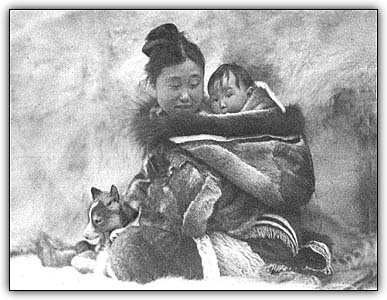
Nyla, Nanook's wife, and her baby at the trading post
Robert Flaherty's "Nanook of the North"
Written by Alain Silver
Original photos from "Nanook of the North"
Web Production and Design,
OneWorld Magazine
|
|
Nyla, Nanook's wife, and her baby at the trading post
Robert Flaherty's "Nanook of the North"
Written by Alain Silver
|
|
|
|
MANY AUTHORS HAVE PREVIOUSLY CHRONICLED the circumstances surrounding the
transformation of Robert Flaherty from professional explorer to professional
filmmaker, from making maps of the Hudson Bay and searching for ore
deposits for the Canadian railways and mining companies to making the
silent film for Revillion Freres that became Nanook of the North.
Released in 1922, Nanook is cited by most film historians as the first feature-length
documentary. Flaherty himself recounted numerous details about its
making in his 1924 book, My Eskimo Friends. By the time it was published
the film had become an international success and Allariallak, the Inuit of
indeterminate age who portrayed "Nanook the Bear," had died of
starvation on a deer hunt.
Flaherty's ethnographic impulse was born of his repeated encounters and interaction with native people during his work as a surveyor and prospector. As early as 1913, this nascent desire to record another culture led him to bring along a motion picture camera. All 70,000 feet of that early shooting went up in smoke when ash from Flaherty's cigarette ignited the cellulose nitrate base on his negative. Believing that much of what he had lost was "too crude to be interesting," Flaherty published a book, The Drawings of Ennoesweetok of the Sikosilingmiut Tribe of the Eskimo, and used a surviving print of his first movie to get financial backers for what would become Nanook of the North.
A particularly stark yet elegiac sequence is the final hunt for the Orjuk or great seal. After finding a blow hole in the ice, Nanook waits patiently for the moment to fling his harpoon. Using eight shots, Flaherty captures his formidable struggle with the unseen prey. No one can say how long Nanook actually wrestled with the Orjuk. Flaherty's sequence lasts just over two minutes; but the intensity of the event, as Nanook repeatedly hauls in line only to be jerked down and dragged over the ice back to the blow hole, is fully rendered. A striking final camera angle, in two parts, captures the moment when Nanook knows he has won. He waves to his wives and children, and, while he holds on in the foreground, they come across the ice behind him in real time and help pull out the catch. (Continues Next Page) The Author - Bibliography - About The Video - Related Links OneWorld Magazine is hosted By The EnviroLink Network and produced by webStories,Inc. - OneWorld Magazine Copyright © 1996, webStories, Inc. All Rights Reserved - Read Important Information |
|
 Flaherty's blue-green sensitive Orthochromatic stock helped him to render
the rugged geography of the sub-arctic in painterly tones. His particular
appreciation of the stark beauty of the Northwest Territories and the
stoic resilience of its natives had developed up over a lifetime. Beginning
with map-making excursions with his father while he was still a child,
Flaherty's relationship to the terrain was pre-defined by his own work as
a cartographer and mineralogist. As one title card suggests, the North is
a place of "Long nights--the wail of the wind--snow smoking fields of
sea and plain--the brass ball of sun a mockery in the sky..." With
camera movement restricted to brief panning or tilting, Flaherty used the
movement of nature--a boat skimming the floe-filled waves of the summer waters,
the feathery fingers of mist snaking over the winter ice--to introduce
the seasons and to create a sense of pantheistic animation amid the desolate
splendor. But Flaherty's film is first and last a document of native people.
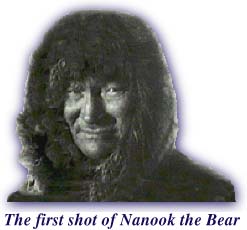
Some of his bias, his admiration for Nanook and his ilk, is clear from the
opening. A title reads: "Chief of the 'Itivimuits' and as a great hunter
famous though all Ungava--Nanook, The Bear." Then a tight close-up
reveals a fur hooded Nanook. As he looks up and to camera left with an
expression that is tranquil and bemused, the image is held for several
seconds and reveals more than any title possibly could. Nanook's lined
and weathered face will seldom be seen this close again, most notably in
the film's last shot of him sleeping in the igloo. By bracketing the entire
film with these intimate portraits of its title character, Flaherty
makes Nanook of the North indelible human drama.
Flaherty's blue-green sensitive Orthochromatic stock helped him to render
the rugged geography of the sub-arctic in painterly tones. His particular
appreciation of the stark beauty of the Northwest Territories and the
stoic resilience of its natives had developed up over a lifetime. Beginning
with map-making excursions with his father while he was still a child,
Flaherty's relationship to the terrain was pre-defined by his own work as
a cartographer and mineralogist. As one title card suggests, the North is
a place of "Long nights--the wail of the wind--snow smoking fields of
sea and plain--the brass ball of sun a mockery in the sky..." With
camera movement restricted to brief panning or tilting, Flaherty used the
movement of nature--a boat skimming the floe-filled waves of the summer waters,
the feathery fingers of mist snaking over the winter ice--to introduce
the seasons and to create a sense of pantheistic animation amid the desolate
splendor. But Flaherty's film is first and last a document of native people.
Some of his bias, his admiration for Nanook and his ilk, is clear from the
opening. A title reads: "Chief of the 'Itivimuits' and as a great hunter
famous though all Ungava--Nanook, The Bear." Then a tight close-up
reveals a fur hooded Nanook. As he looks up and to camera left with an
expression that is tranquil and bemused, the image is held for several
seconds and reveals more than any title possibly could. Nanook's lined
and weathered face will seldom be seen this close again, most notably in
the film's last shot of him sleeping in the igloo. By bracketing the entire
film with these intimate portraits of its title character, Flaherty
makes Nanook of the North indelible human drama.
 Shot after shot reasserts the harshness of an environment where nothing
grows. But its inhabitants, whom Flaherty introduces as the "fearless,
lovable, happy-go-lucky Eskimo," are remarkably insouciant in the face
of an unending life-and-death struggle. Despite the wording of his titles
and even in the trading post scenes, where Nanook barters for beads and
marvels at a gramophone, Flaherty's visual record is remarkably free of
"civilized" condescension. From the shot of Nanook biting the
edge of a gramophone disc, the viewer is quickly transported to the fishing
grounds where Nanook bites his catch and "kills the big ones with his
teeth." All the sequences which follow, from the rush of kayaks across
choppy waters to the Walrus hunt to Nanook's single-handed construction of
an igloo with only an ivory knife blade for a tool, reaffirm the dauntless
vitality of the Inuit.
(Photo Above: Nanook on the uplifted ice of Hudson Bay.)
Shot after shot reasserts the harshness of an environment where nothing
grows. But its inhabitants, whom Flaherty introduces as the "fearless,
lovable, happy-go-lucky Eskimo," are remarkably insouciant in the face
of an unending life-and-death struggle. Despite the wording of his titles
and even in the trading post scenes, where Nanook barters for beads and
marvels at a gramophone, Flaherty's visual record is remarkably free of
"civilized" condescension. From the shot of Nanook biting the
edge of a gramophone disc, the viewer is quickly transported to the fishing
grounds where Nanook bites his catch and "kills the big ones with his
teeth." All the sequences which follow, from the rush of kayaks across
choppy waters to the Walrus hunt to Nanook's single-handed construction of
an igloo with only an ivory knife blade for a tool, reaffirm the dauntless
vitality of the Inuit.
(Photo Above: Nanook on the uplifted ice of Hudson Bay.)