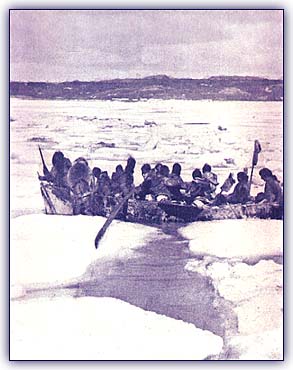
The omiak or women's boat coming down to the trading post
|
|
The omiak or women's boat coming down to the trading post |
|
|
Robert Flaherty's "Nanook of the North"
(Continues from Previous Page) Written by Alain Silver
|
|
|
|
IN HER BOOK, The Odyssey of a Film-maker, Flaherty's collaborator and
widow France Hubbard Flaherty reasserts the frequently applied epithet of
"Father of the Documentary." She also claims that "his films
themselves do not give evidence of a method, that is the apparatus of
film-making and its devices." Certainly in Nanook Flaherty
had few apparati at his disposal: two hand-cranked Akeley cameras and a
minimum of supporting equipment. Perhaps the most remarkable technical
accomplishment of filming in arctic conditions in 1919 and 1920 was not
that Flaherty's cameras withstood the cold, but that he and his Eskimo
aides successfully disassembled them at the end of every shooting day to
wipe the condensed moisture from their inner workings and put them back
together to face the cold again. Even more extraordinary was that Flaherty
turned his Hudson Bay cabin into a film lab, where he not only heated vats
of chemicals with enough precision to process his negative but also printed
dailies with sunlight by running the negative and positive film past a
frame-sized hole.
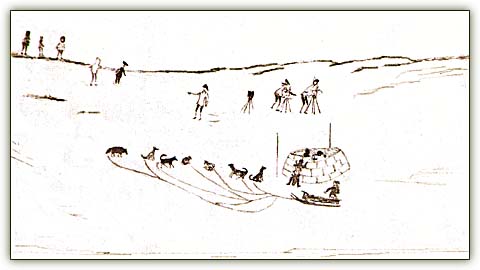
Flaherty has sometimes been criticized by subsequent generations of documentarians for his "reconstruction" of scenes, most notably inside the igloo. Since the real thing was much too small and dark for filming, Flaherty's actors built an oversized model. This igloo mansion collapsed in early attempts and, even when finally built with numerous ice windows, was still too dark. Flaherty ultimately removed portions of the ceiling to let in enough sunlight. Remarkably no contemporary viewers seemed to notice in the film's final sequence that Nanook and his family were taller than the deserted igloo into which they crawled for shelter, but that once inside they stood unencumbered beneath a vaulted dome. In fact, while it may be a far cry from cinema verité, the attempt to make a large-scale ice house was consistent with the ethnographic principal of recording the people of any culture in the environment as it is. How much simpler would it have been to shoot the Inuit family's snow-bed in full daylight against a wall of ice blocks, and who would have noticed? For those who believe that documentary and ethnographic filmmaking has evolved into a convention in which the filmmaker tries to remove as much of his or her cultural bias as possible, Flaherty did just that in his depiction of the events inside the igloos. While the Inuit drawing of Flaherty the kabloonak or Westerner directing his two native cameraman affirms the director's control, he chose to keep his mediating influences in check.
The Author - The Story - Bibliography - About The Video - Related Links OneWorld Magazine is hosted By The EnviroLink Network and produced by webStories,Inc. - OneWorld Magazine Copyright © 1996, webStories, Inc. All Rights Reserved - Read Important Information |
|
 Today's "reality based" filmmakers have made televised
reconstruction an operative method. Still it could be argued that
Flaherty's most serious manipulation of the subject was to pay both
his technical assistants and his performers. For Flaherty this was
essential to control Nanook's nomadic life-style. "Do you know
that you and your men may have to give up making a kill," Flaherty
recounted telling Nanook, "if it interferes with my film? Will you
remember that it is the picture of you hunting the iviuk [walrus] that
I want, and not their meat?" Years before terms like documentary
or ethnographic film were being debated, Flaherty had an instinctive
understanding of the phenomenology of his art. Perhaps it was clear
from the reactions of his performers when he projected the film of
the iviuk hunt for them. The Inuit--not unlike the Parisians who
watched scenes filmed by the Lumière brothers 100 years ago
and fled the grainy image of an approaching train--were slightly
confused between the depiction and the actual event. For them, the
walrus hunt meant food and life. Through the film they relived the
excitement without the "meat." For Flaherty, it had to be
the record of the event and not the event itself that mattered. The
title might read, "The desert interior, if deer hunting fails,
is the country of death;" but the only the images could silently
evoke that grim reality. And long after Nanook had indeed starved to
death, people looking at that record, people who, Flaherty noted
ironically, "must be told that white means snow" could
see the record of those events and understand something of the
arduous existence which Nanook led.
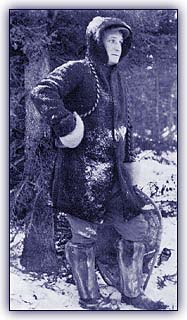
(Photo above: Flaherty at Moose Factory (southern Hudson Bay)
during his early explorations)
Today's "reality based" filmmakers have made televised
reconstruction an operative method. Still it could be argued that
Flaherty's most serious manipulation of the subject was to pay both
his technical assistants and his performers. For Flaherty this was
essential to control Nanook's nomadic life-style. "Do you know
that you and your men may have to give up making a kill," Flaherty
recounted telling Nanook, "if it interferes with my film? Will you
remember that it is the picture of you hunting the iviuk [walrus] that
I want, and not their meat?" Years before terms like documentary
or ethnographic film were being debated, Flaherty had an instinctive
understanding of the phenomenology of his art. Perhaps it was clear
from the reactions of his performers when he projected the film of
the iviuk hunt for them. The Inuit--not unlike the Parisians who
watched scenes filmed by the Lumière brothers 100 years ago
and fled the grainy image of an approaching train--were slightly
confused between the depiction and the actual event. For them, the
walrus hunt meant food and life. Through the film they relived the
excitement without the "meat." For Flaherty, it had to be
the record of the event and not the event itself that mattered. The
title might read, "The desert interior, if deer hunting fails,
is the country of death;" but the only the images could silently
evoke that grim reality. And long after Nanook had indeed starved to
death, people looking at that record, people who, Flaherty noted
ironically, "must be told that white means snow" could
see the record of those events and understand something of the
arduous existence which Nanook led.
(Photo above: Flaherty at Moose Factory (southern Hudson Bay)
during his early explorations)