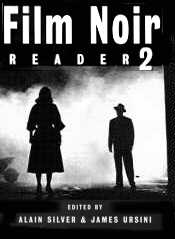
Film Noir Reader 2 reproduces eight more seminal essays on film noir and sixteen other articles.
The Contents page is reproduced below.
[To order from Amazon Books CLICK HERE or on the cover.]
The seminal essays in this new volume are designed to complement those of our earlier anthology and includes several pieces from the 1940s. Lloyd Shearer writes on noir in the New York Times more than year before either Nino Frank or Jean-Pierre Chartier thought of giving it a name. As the classic period wound down, Claude Chabrol writing for Cahiers du Cinéma sustained the critical discussion of film noir culminating with Raymond Borde and Étienne Chaumeton's book-length. French-language study in 1955 (see the first Film Noir Reader). Tom Flinn's 1972 piece is one of the first in depth articles on particular aspects of noir. Two years later, Stephen Farber's social analysis (and Richard Jameson's piece in Part III) appeared in a special film noir section of Film Comment in 1974. Marc Vernet's 1983 article redefines the thrust of French criticism Finally Dale Ewing "Film Noir: Style and Content." closes out Part One with a solid recapitulation of critical writing that goes all the way back to Chartier and Frank.
Parts Two and Three of this new volume again put the noir phenomenon in closer focus through Case Studies and review its evolution within and after the classic period. Robin Wood provides close analysis of creativity and authorship through The Big Heat and Kiss Me Deadly, Francis Nevin surveys Cornell Woolrich, and Robert Porfirio considers the two adaptations of The Postman Always Rings Twice. Elizabeth Ward reflects on the impact of Double Indemnity on subsequent classic period noir films starring Barbara Stanwyck and Fred MacMurray, and Alain Silver revisits the darker expectations of landscape in Hitchcock. New pieces include Grant Tracey's study of director Sam Fuller's extravagant contributions to film noir as "tabloid cinema," Robert Porfirio's consideration of jazz and classic noir, and more neo-noir fugitive couples. Part Three delves further into the boundaries and influences of classic film noir as evidenced not only by the on-going vitality of neo-noir as a genre in the U.S. and throughout the world. The beginnings of neo-noir which are recapitulated in the reprint of Richard Jameson's 1974 "Son of Noir" and the newest reprint, Sharon Cobb's internet article for would-be screenwriters, suggests upcoming new directions. Several all new essays consider noir's relationships to other types of films and other types of art: James Ursini considers science fiction and noir; Tony Williams, British film noir; Kent Minturn, abstract expressionism and noir; and Linda Brookover, crime photography and noir. Another new piece by William Covey tracks the evolving relationship of film noir and women as neo-noir protagonists and filmmakers. Finally, mindful of the fact that the first Film Noir Reader was well received as a reference text for survey courses, we have concluded with Philip Gaines' schematic for such a course.

Part One: More Seminal Essays
Crime Certainly Pays on the Screen
Lloyd Shearer (1945)
A New Kind of Police Drama: the Criminal Adventure
Nino Frank (1946)
Americans are also Making Noir Films
Jean-Pierre Chartier (1946)
The Evolution of the Crime Drama
Claude Chabrol (1955)
Three Faces of Film Noir
Tom Flinn (1972)
Film Noir: Society. Violence and the Bitch Goddess
Stephen Farber (1974)
The Filmic Transaction: On the Openings of Film Noirs
Marc Vernet (1983)
Film Noir: Style and Content
Dale E. Ewing, Jr. (1988)
Part Two: More Case Studies
Whatever Happened to the Film Noir? The Postman Always Rings Twice
(1946-1981)
Robert G. Porfirio
Creativity and Evaluation: Two Film Noirs of the Fifties
Robin Wood
Fragments of the Mirror: Hitchcock's Noir Landscape
Alain Silver
The Unintended Femme Fatale: The File on Thelma Jordan and Pushover
Elizabeth Ward
Translate and Transform: from Cornell Woolrich to Film Noir
Francis M. Nevins
Film noir and Samuel Fuller's Tabloid Cinema:Red (Action), White
(Exposition) and Blue (Romance)
Grant Tracey
Dark Jazz: Music in the Film Noir
Robert Porfirio
Mad Love is Strange: More Neo-Noir Fugitives
Alain Silver and Linda Brookover
Part Three: The Evolution of Noir
Son of Noir
Richard Jameson
Writing the New Noir Film
Sharon Y. Cobb
Blanc et Noir: Crime as Art
Linda Brookover
Noir Science
James Ursini
British Film Noir
Tony Williams
Peinture Noire: Abstract Expressionism and Film Noir
Kent Minturn
Girl Power: Female Centered Neo-noir
William Covey
Noir 101
Philip Gaines
Notes on Contributors
For catalog information on Film Noir
Reader 2 you can contact Limelight Editions via FAX at (973) 835-6504, E-mail at "limelighteditions@earthlink.net "
 ,
or snail mail at 512 Newark Pompton Turnpike, Pompton Plains, NJ 07444.
,
or snail mail at 512 Newark Pompton Turnpike, Pompton Plains, NJ 07444.
OR
